This global equity income fund refuses to shun the US or tech stocks

Delivering income and capital growth in the same vehicle is a ‘tug of war’, according to Allspring’s Wai Lee.
A global equity income fund does not have to be wholly value-driven, anti-US or wary of technology stocks to successfully deliver income, according to Wai Lee, co-manager of Allspring Worldwide Global Equity Enhanced Income.
“Clients have previously made us aware of their frustration with their past experiences of global equity income funds, which have been [designed in this way],” Lee said.
This traditional approach is largely a product of the inherent difficulty of delivering income and capital growth simultaneously – a “tug of war”, in his words – but one he said the Allspring Worldwide Global Equity Enhanced Income fund was designed to resolve.
The £1.5bn strategy aims to deliver income without giving up capital growth and beating the MSCI ACWI benchmark in a risk-balanced manner – with no bias against any regions, sectors or styles.
Indeed, the fund’s top holdings show this flexibility, with big tech names such as Nvidia and Microsoft alongside more defensive financials like Citigroup and Sompo Holdings.
As shown in the table below, a £10,000 investment in 2020 would be worth £18,790.90 by the end of 2025, with £2,967.30 in dividends and £5,823.60 in capital appreciation.
Source: FE Analytics
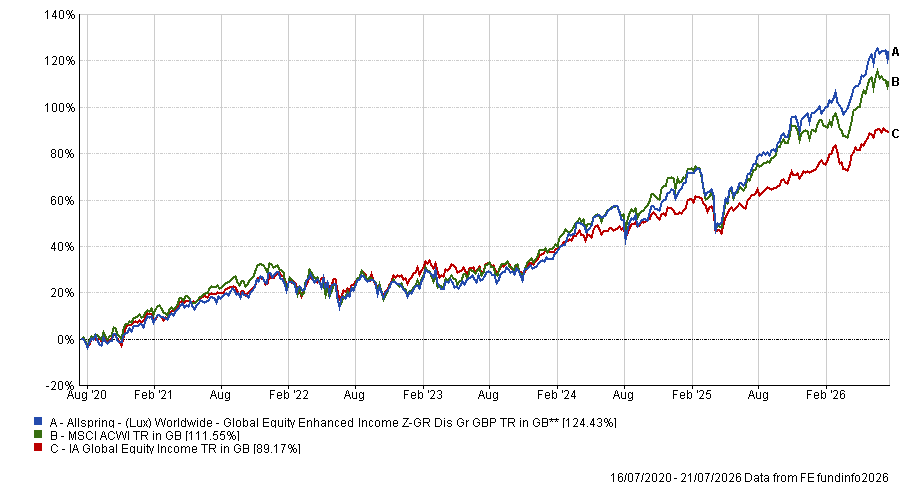
Since launch, the fund – which Lee co-manages fund alongside Vince Fioramonti, Petros Bocray, Megan Miller and Justin Carr – has overall returned 120.8%, beating both the MSCI ACWI index and the IA Global Equity Income average.
Performance of the fund vs sector and benchmark since launch
Source FE Analytics
Below, Lee explains how the fund is constructed differently from its peers, his role within the management team and recent wins and losses.
How do you look at income versus capital growth?
When we launched the strategy in 2020 we thought carefully about what the right level of income was – and decided 6% is achievable without pushing ourselves to overload on super high dividend yield stocks, which would risk eliminating a lot of the alpha opportunities.
Having launched during the height of Covid, it was a challenging environment, so a higher contribution to that 6% came from options premium. But as monetary policy normalised, we can now draw most of our income from securities – roughly two-thirds from securities dividends and the rest from index options.
We start with a benchmark-aware approach and try to stay within plus or minus 5% in both regions and sectors. We can hold up to 10% of the portfolio in non-dividend-paying stocks. That is why when you look at our top 10 holdings, most of the Magnificent Seven are there, which is quite unusual for an income fund.
On the capital growth side, our track record is a reflection that we can deliver alpha in parallel to income. We don’t have a one-size-fits-all approach. Beyond looking at sectors and regions, we also look at whether companies are high growth and high stability, or low growth and high stability. There are many ways to dissect the universe, and we try to have a comprehensive, multiple angles approach to harvest the alpha.
How would you describe your role and process in the management team?
I have been head of research at the firm since 2018 and joined the management team in the third quarter of 2024. It came about as a natural progression, given that I was already driving the research agenda. The one thing I don’t do is trade the securities.
On the research side, we start with a universe of a few thousand stocks and narrow it down to between 100 to 200 highly ranked and attractive names. Our current portfolio has around 75 names and those are determined by my fellow co-managers.
What have been your best and worst calls over the past 12 to 18 months?
From the AI adopter perspective, we saw opportunities in banks, particularly in Europe, in pharmaceuticals and some selected software companies we thought could be underrated by the market.
Citigroup is a good example. It is a classic case of a bank turning itself around – exiting non-core retail operations, cutting costs and restoring earnings growth. In 2026, its revenue has grown by almost 15% year-on-year and earnings by more than 50%.
We saw it as a stock with improving fundamentals from a low valuation base, driving a sharp re-rating by the market.
The stock went up about 70% in the past year and we are still holding it as one of our top 10 positions.
Our worst call was in the consumer discretionary sector – specifically Booking Holdings, the online travel company.
It was favourably ranked across many of the metrics we follow, including valuation, quality, profitability and earnings outlook, and we held an overweight position.
But margins and earnings visibility came under pressure from elevated investment in AI and a softer travel backdrop and the stock fell more than 20% in the past year.
We are still holding a small overweight – no more than 1% – because we disagree with the view that AI is a threat to the company. We believe agentic AI should help a company like this navigate a complex travel ecosystem.
What do you get up to outside of fund management?
I like eating, exercising and competing in Mahjong tournaments.